Marigolds
Animation: Aleksandra Nikolic Sound: Aleksandra Nikolic
Plant Whisper
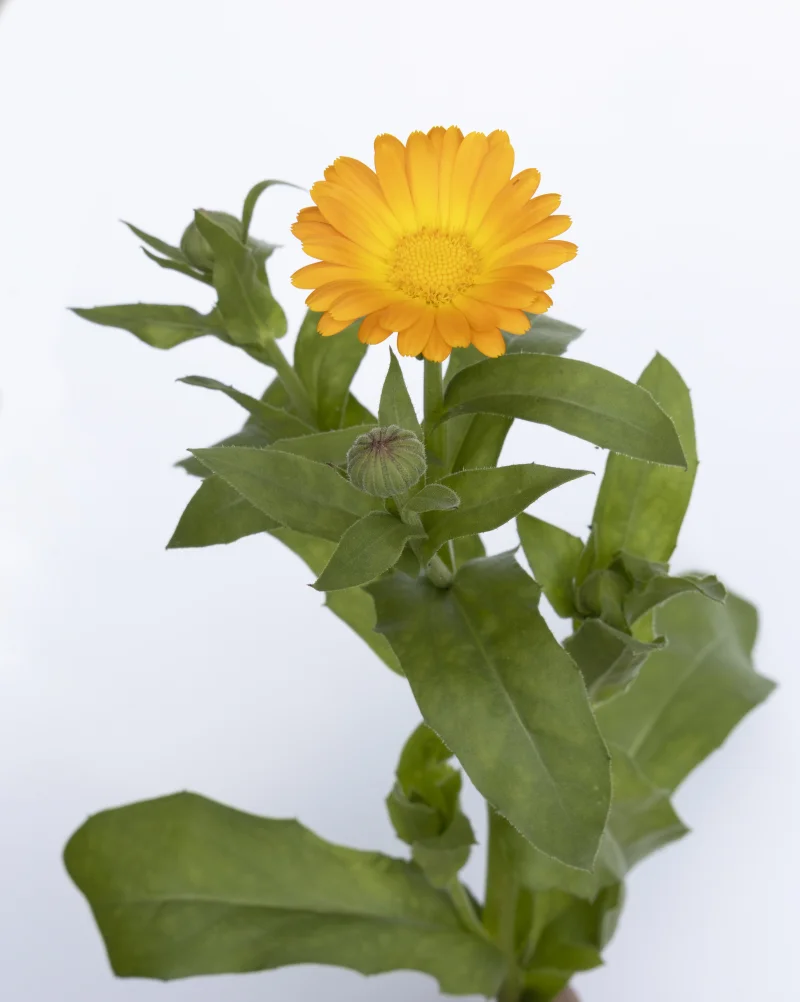
I am the calendula (Calendula officinalis). In the Middle Ages, I migrated from monastery gardens to apothecary and parish gardens, and finally to farm gardens – and have continued to spread over time. I am particularly proud of my vibrant blossoms: large, orange and yellow flower heads. I am incredibly versatile.
Calendula ointment is especially well-known; it has antibacterial, anti-inflammatory, and antifungal properties, as well as reducing swelling. It belongs in every home medicine cabinet, whether for grazes, scrapes, sunburn, chapped lips, minor burns, pimples and teenage acne, or slow-healing wounds. Caution is advised when making your own calendula ointment with lard.
And in the kitchen: The young leaves and blossoms are delicious in salads. Homemade calendula blossom butter can be eaten as a spread on bread or served as a herb butter with grilled meat. The blossoms can also be used as a garnish in salads or desserts.
Caution: If you have an allergy to plants in the daisy family (Asteraceae), you must avoid calendula flowers and preparations made from them.
By the way: My German name, "Ringelblume" (literally "marigold"), comes from my ring-shaped seeds.
I am also depicted realistically in the Garden of Health, although the text confuses me with the caper bush. See the "Medicinal Plant Window" in the FLORA exhibition.
Botanical Facts
 moderately humid
 Not winter-hardy, annual and usually only survives light frost down to about -5 degrees Celsius.
 Mediterranean region; its actual origin can no longer be determined due to its long cultural history.
 June – October
 Full sun location
 They thrive in permeable, nutrient-rich, and loamy soil, but grow in almost all soils.
Healing Properties
Traditional Uses: Hildegard von Bingen considered calendula blossoms to be cold and moist, but due to confusion with the caper bush in her "Garden of Health," she also described them as warming and drying. They "thin and purify phlegm, especially of the skin."
The calendula was also traditionally described as a "sunny all-healer," a powerful wound-healing plant for both physical and emotional wounds and scars. Internally, it was also used for liver and gallbladder ailments.
Modern Medical Perspective: Today, the calendula (Calendula officinalis L.I.) is primarily known for its external use as a wound-healing plant for superficial wounds. Important constituents of the flowers (Calendulae flos) include the essential oil, as well as saponins, carotenoids (the orange flower pigments!), flavonoids, and triterpene alcohols. These have anti-inflammatory and wound-healing properties and, above all, accelerate skin regeneration after injury.
Modern Medical Perspective: Today, the calendula (Calendula officinalis L.I.) is primarily known for its external use as a wound-healing plant for superficial wounds.
Features
 30 - 50 cm
 ❀ Flowers and young leaves
⚕ (historically widespread use without clear proof of effectiveness), non-toxic, not a true food plant, 🔧 (dye plant), 💐 (ornamental plant)
❀ Flowers and young leaves
⚕ (historically widespread use without clear proof of effectiveness), non-toxic, not a true food plant, 🔧 (dye plant), 💐 (ornamental plant)
 An excellent insect-friendly plant, providing abundant nectar and pollen for honeybees, wild bees, bumblebees, and butterflies. As an annual, low-maintenance plant, it blooms from June until the first frost, creating lively activity in the garden and is particularly sustainable due to its self-seeding properties.
 In the humoral pathology section of "Garden of Health" (1485), the text regarding calendula is incorrect and was confused with caper: "hot and dry in the second degree." Unfortunately, this misconception was perpetuated by H. Bock and others! The correct description is: cold and moist, as in "Circa instans" and according to Hildegard von Bingen, also in Traditional Chinese Medicine. This makes sense, as calendula soothes hot, inflamed wounds.
 My German name "Ringelblume"? It comes from my ring-shaped, curved seeds.
Endangerment Level
- Not Evaluated
All information about herbs has been carefully compiled but does not claim to be complete. None of the information provided constitutes medical advice.
GOLDEN RULE for EVERYTHING: Eat only what you know! The rule applies: a handful of wild plants per person and day may be collected on public land. Use only washed plant parts that you can identify clearly – when in doubt, please refrain from using them.
TIP: One advantage of buying over-the-counter medicines from a pharmacy or specialist retailer is the expert advice on your symptoms.